Hugging Face - Your Gateway to the AI Community
What is Hugging Face?
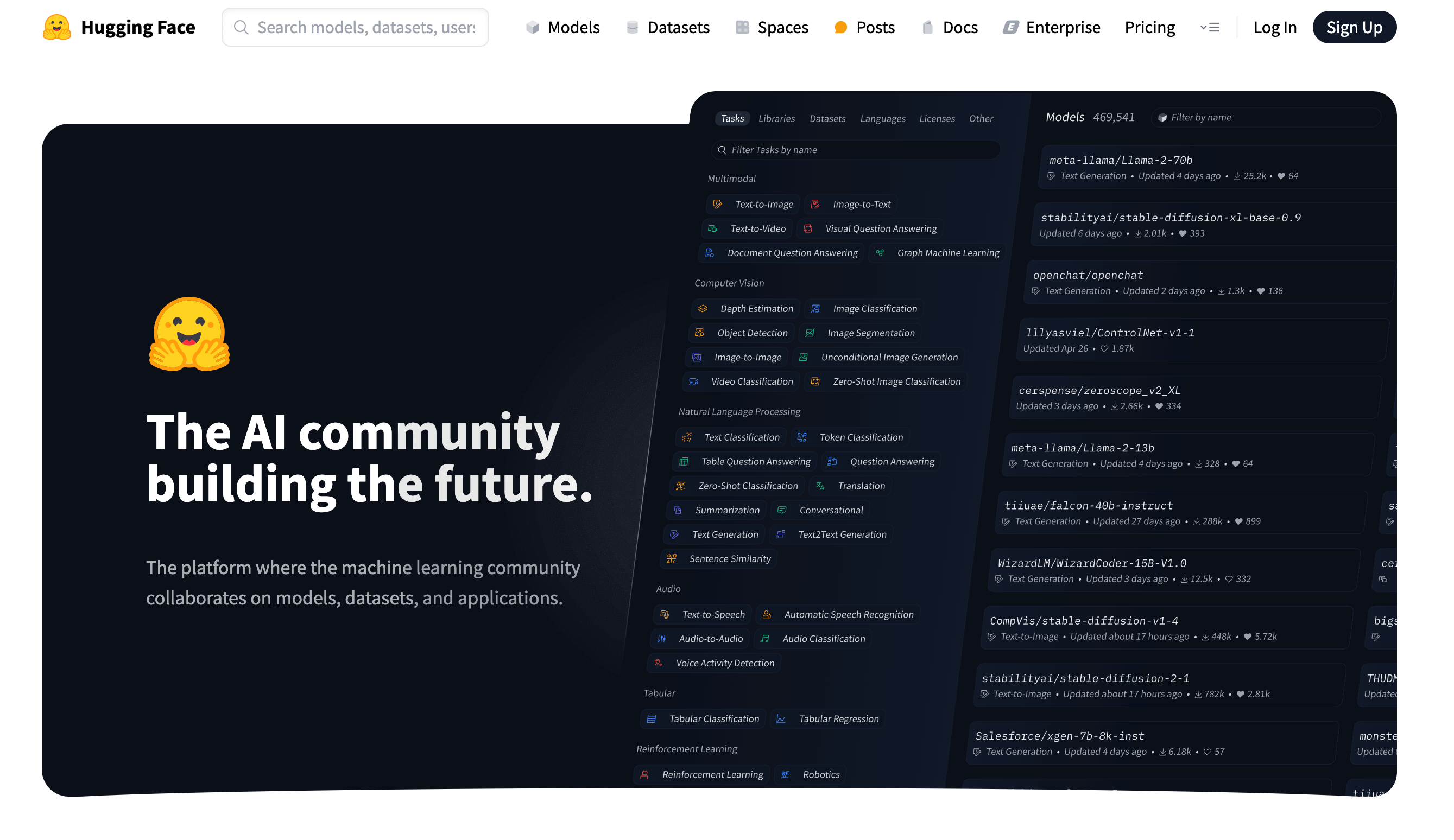
Hugging Face is an AI community that serves as a collaborative platform for the machine learning community. It is a place where individuals and organizations can work together on models, datasets, and applications. With a vast collection of 469,541 models and a wide range of tasks and modalities covered, it has become a hub for AI enthusiasts, researchers, and developers.
How to use Hugging Face?
- Explore Models: You can browse through the extensive list of models available on the platform. For example, if you are interested in text generation, you can find models like Llama-2-70b. You can filter models by name and task to quickly locate the ones that suit your needs.
- Utilize Libraries and Tools: Hugging Face offers various libraries such as Transformers, Diffusers, and Tokenizers. You can use the high-level helper from Transformers like the
pipelinefunction for tasks like text generation. For image generation, you can use Diffusers'DiffusionPipeline. - Collaborate on Projects: Join the community to collaborate on public models, datasets, and applications. You can create, discover, and work together with others to improve and expand the capabilities of different AI projects.
- Share Your Work: Build your portfolio by sharing your work with the world. This helps you establish your presence in the ML community and contribute to the growth of the field.
Hugging Face's Core Features
- Diverse Model Repository: It hosts a large number of models for different tasks including text generation (e.g., Llama-2 series), image generation (e.g., Stable Diffusion series), and more. These models cover multiple modalities such as text, image, video, and audio.
- Open Source Tools: Provides state-of-the-art open source libraries like Transformers for ML in Pytorch, TensorFlow, and JAX, and Diffusers for image and audio generation. These tools enable users to easily implement and experiment with different AI techniques.
- Collaboration Platform: Facilitates collaboration among the machine learning community. Users can host and work together on unlimited public models, datasets, and applications, promoting knowledge sharing and innovation.
- Task and Modality Coverage: Supports a wide range of tasks such as text classification, translation, question answering, and computer vision tasks like image classification and object detection. It also covers various modalities, allowing for comprehensive AI development.
FAQ from Hugging Face
Is Hugging Face available?
Yes, Hugging Face is an online platform that is accessible to users around the world. You can visit the website at https://huggingface.co/ to access its features and resources.
What does Hugging Face do?
Hugging Face provides a platform for the machine learning community to collaborate on models, datasets, and applications. It offers a vast repository of models for different tasks and modalities, along with open source libraries and tools to aid in the development and implementation of AI projects. It also enables users to share their work and build a portfolio in the ML field.
Is Hugging Face free?
Hugging Face offers many free resources. You can access and use a large number of models, libraries, and datasets without any cost. However, it also provides paid Compute and Enterprise solutions for those who require additional features and support. The starting price for GPU compute is \(0.60/hour, and the Enterprise solution starts at \)20/user/month.
When was Hugging Face released?
The specific release date of Hugging Face as a platform is not provided in the given article. However, it has been actively evolving and growing over time, with continuous updates to models and features.
Is Hugging Face as good as other tools?
Hugging Face has its own unique strengths. It stands out for its large and diverse model repository, strong community collaboration, and comprehensive open source toolset. Compared to other tools, it offers a wide range of models for different tasks and modalities, making it a go-to platform for many in the AI community. However, the choice between Hugging Face and other tools depends on specific requirements. For example, if you need a highly specialized model for a particular application, you may need to compare the available models on Hugging Face with those on other platforms. But overall, Hugging Face's extensive offerings and community-driven nature give it a significant edge in the field of AI development and research.