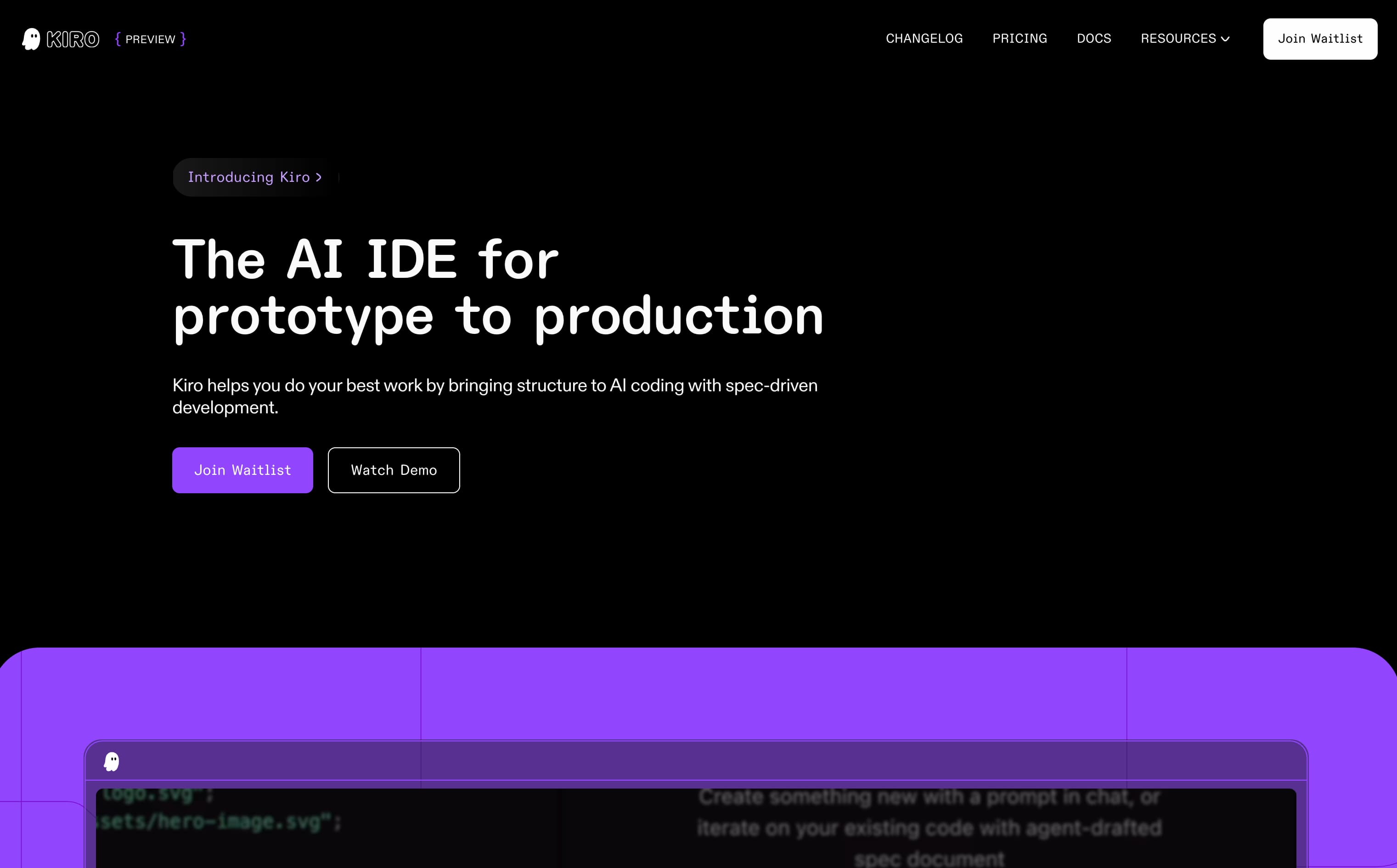
Kiro – Agentic AI‑powered IDE for Spec‑Driven Development
What is Kiro?
Kiro is a next‑generation AI IDE from AWS that goes beyond simple code assistance. It uses autonomous “agents” to turn high‑level prompts into structured software systems—complete with specifications, plans, implementation, and automatic validation. It helps developers move from prototype ("vibe coding") to production-ready code.
Why Use Kiro?
- Spec‑Driven Workflow: Generates requirements, design docs, and task plans directly from your prompt.
- Agent Hooks: Automates repetitive tasks like test generation, documentation updates, and security checks triggered by code changes.
- Enterprise‑Grade Structure: Maintains code consistency, prevents technical debt, and preserves developer knowledge.
- Rich Context Management: Supports Model Context Protocol (MCP), multimodal input (images, files), steering rules, and agentic chat.
Core Features
- Specs & Planning: Define a feature in natural language. Kiro auto-generates
requirements.md,design.md, andtasks.md, with live sync as you code. - Agent Hooks & Automation: Event-driven agents run automatically on file save, commit, or other triggers—updating tests, docs, or scanning for issues.
- Project Steering: Control how agents work via steering markdown files, specifying architecture, tooling, and coding standards.;
- Autopilot & Supervisory Mode: Let agents carry out sequences of tasks automatically (Autopilot), or step through each change manually (Supervised).
- Transparent Code Review: View agent-made changes as diffs, accept or reject each suggestion.
- VS Code Compatibility: Runs on Code OSS and supports Open VSX extensions, themes, and developer settings.
How to Get Started
- Request access via the preview waitlist on kiro.dev.
- Download the IDE on macOS, Windows, or Linux.
- Open your project folder (or run
kiro .in CLI). - Generate steering docs to define your project's structure and standards.
- Create a spec: Describe a feature in chat; Kiro builds spec and tasks.
- Run tasks: Select a task, let Kiro generate code/tests/docs.
- Set up hooks: Automate docs/tests/security checks on file events.
- Review changes using live diffs and commit when ready.
Usage Tips
- Start with specs for complex features—ensures clarity and maintainability.
- Use Agent Hooks to keep tests and docs up-to-date automatically.
- Tune project steering files to match your team's style and standards.
- Enable Autopilot mode for faster execution, or stay in Supervised mode when precise control is needed.
FAQ
Q: Is Kiro free?
A: During public preview, Kiro is free. Post-preview pricing: a free tier with 50 agent interactions/month, Pro (\(19/mo for 1,000), and Pro+ (\)39/mo for 3,000).
Q: How is it different from GitHub Copilot?
A: Copilot provides inline code completions. Kiro goes further—it understands feature goals, works across multiple files, generates specs, automates tasks, and provides agents.
Q: Does it run locally?
A: Yes, the IDE runs locally. AI processing can happen in the cloud, but all code stays on your machine unless opted in.
Q: What AI models does it support?
A: Currently powered by Anthropic Claude Sonnet (3.7 & 4.0). More models expected soon.
Q: Can I use it with existing VS Code setups?
A: Yes. Kiro supports VS Code themes and Open VSX extensions.